I totally blame my mother-in-law for this (who is, no offense to anyone present, the best human on the planet), but I started getting into the dark arts of sewing and quilting. I’ve always done some of it – you know me and my costumes – but this woman was a freakin’ legend in the quilting world for a while.
She retired from quilting when my father-in-law started developing Alzheimer’s-like dementia, and after he passed, she said that “the mojo was gone”. Her time as an active world-famous quilter was passed, and she distributed her considerable stash among a few recipients, one of which was me.
This stash had more than just her unused fabric, though. (And this wasn’t “designer print” fabric, we’re talking hand-painted, hand-dyed, single-run fabrics, among others.) There were also several of her unfinished pieces in various states of undress.
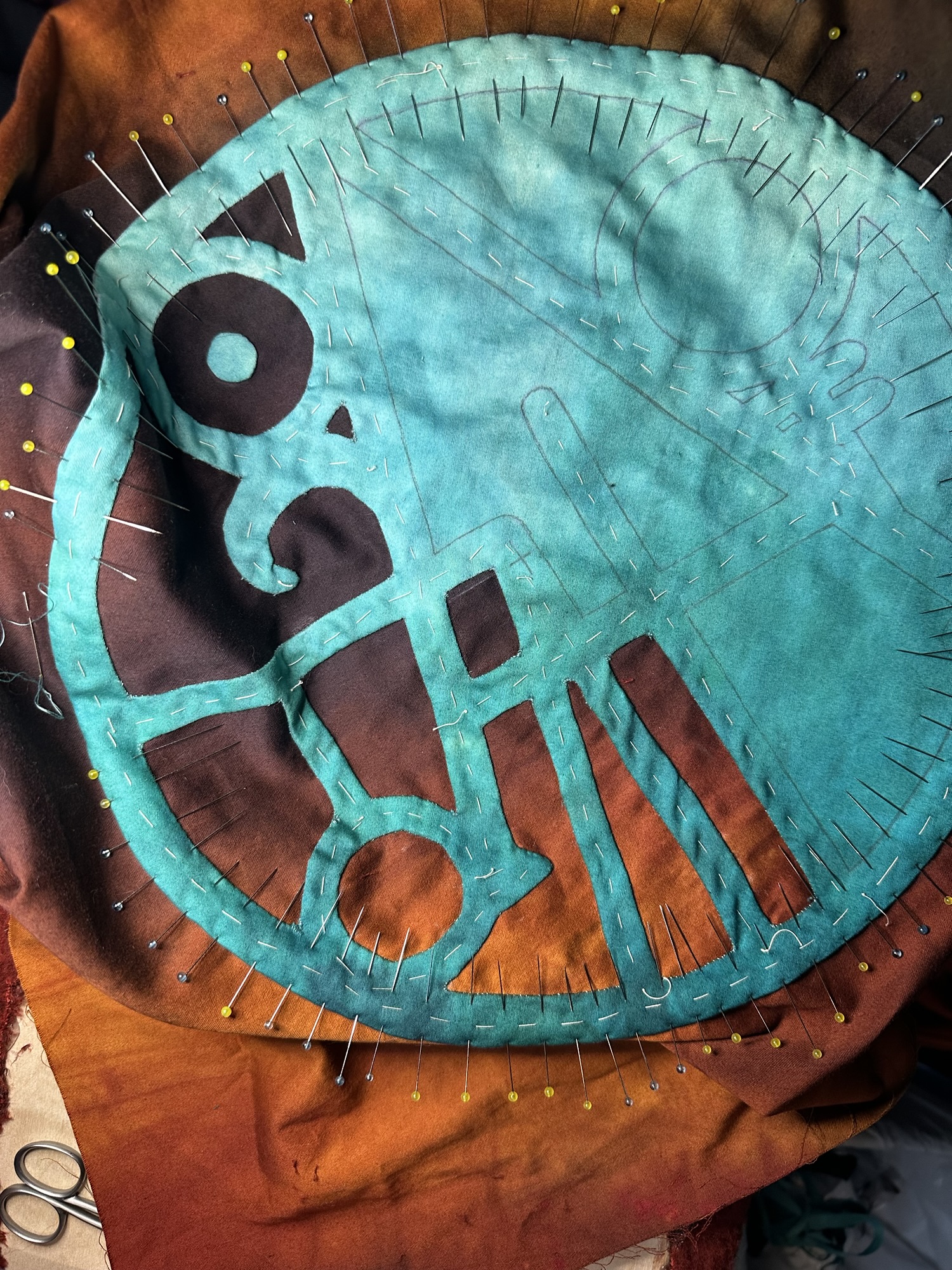
Understand this well, and then grasp where my madness lies: Mom did nearly everything on her quilts by hand. They are all needle-turn appliqued (and reverse applique), and the vast majority of her pieces are also hand quilted.
So, I did what any absolutely crazy person would do: I picked up the unfinished pieces, tried to figure out how she did it, and then went to work completing them. And then I drove myself even more nuts trying to figure out how she got these tiny, teeny stitches. (Answer: obscene amounts of practice.)
I sat at her knee a couple of times to watch her technique and try to emulate it as well as I could, and the conversation naturally turned to why she made her quilts the way she did. She could have used the machine (and she did machine quilt some larger pieces that didn’t require a lot of quilt detail), but the joy and the power was in doing everything by hand.
For her, the point was not just to make a quilt. It was to create art wherein the method was as intrinsically a part of the beauty of it as the fabric or the form. Preserving the skill of handiwork – hand-pieced quilts, appliqued quilts, hand quilting, hand-stitched clothing, and so on – was a much her motivation as producing the object. Yes, her quilts sold for stupid amounts of money because they were just that incredible, but she made most of her reputation and fortune by teaching.
She doesn’t want the art of handiwork to die. (And given that we might not always have things like functional electric grids, I can see the practicality of it.)
(She’s also a slightly witchy lady of the might, so she totally vibed with the next part.)
My Croning has begun, and with it, the calls of all kinds of mystical and occult things are reaching a high keen. This current cycle is focused on Norse mythology and culture – not “viking”, that was a job/verb, not an ethnic identity – and I’ve been working on elder futhark, bindrunes, and sigils in particular. The muses are guiding me to cast many of these in fabric – collapsible, lightweight, durable – and that means a lot of handiwork.
Lucky for you guys, I’m fast and not terrible at it. And I am getting better all the time.
If all goes according to Hoyle, I’ll have the first batch of bindrune home blessings available at FaeFest on May 9, 2026, in Austin, Texas, plus maybe some nice lap quilts. (Early-bird tickets are on sale right now.)
Because magic is always better with friends, I’m also bringing a bunch of stuff from some other artist friends of mine who can’t bring their own booth, but that’s another story.
The point right now is that there’s a special kind of spark in these panels and pieces that I’ve been making, something distinctly personal and yet compassionate and giving. It’s hard to describe right now, but I think when you come around and take a look at what I’ve got cooking, you’ll get it.
In the meantime, don’t bother sending more thimbles. The callous is going to happen regardless.

No responses yet